Water Damage in Office and Multifamily Properties: The Right Response Before a Leak Becomes a Major Loss

Water is one of the most persistent risks facing commercial real estate. A failed plumbing connection, an overflowing fixture, a leaking HVAC system, a broken sprinkler pipe, a roof intrusion, or a ruptured water heater can lead to a significant property loss surprisingly quickly. In a high-rise building, the problem becomes even more complicated because water rarely stays where the failure occurs. It travels vertically through floors, walls, elevator shafts, electrical rooms, ceilings, and mechanical spaces, potentially affecting multiple tenants or residents before the source is even identified.
For building owners, the difference between an inconvenient water incident and a major financial loss often comes down to how the first several hours are handled.
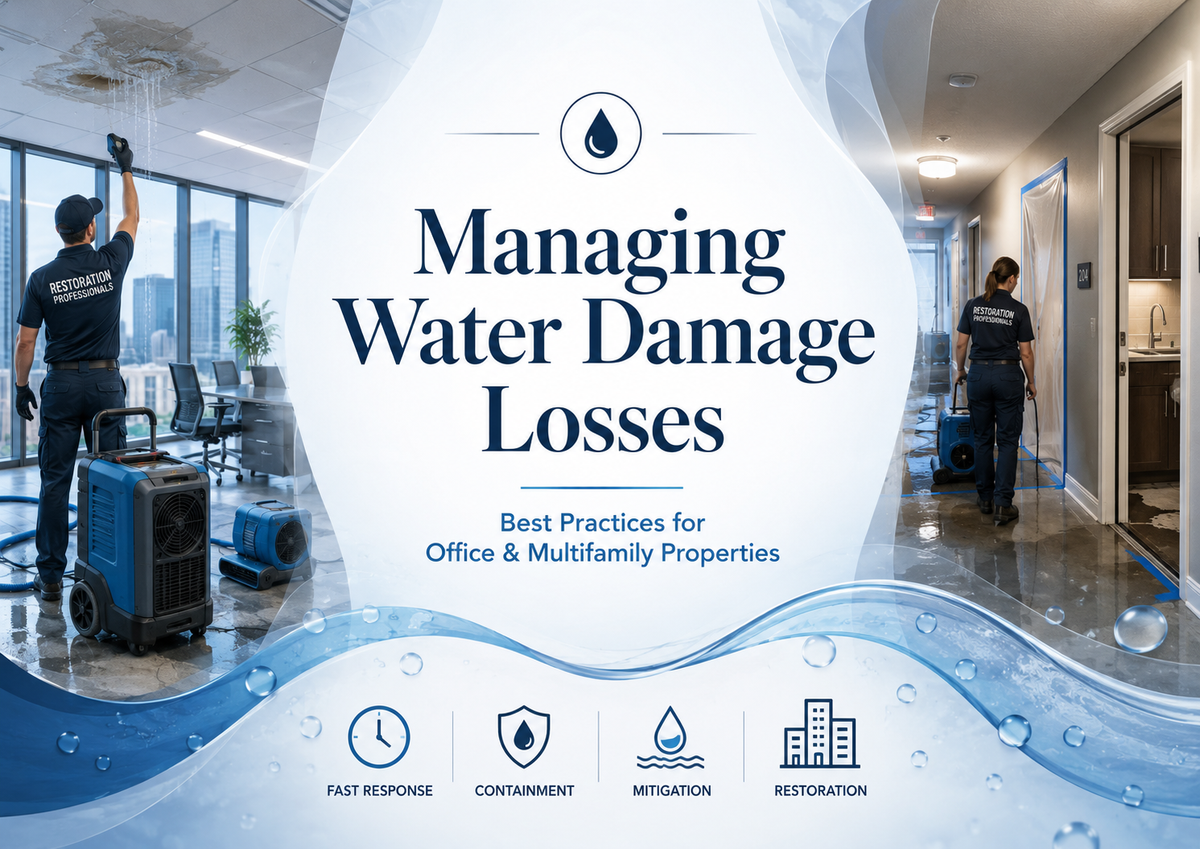
The basic principles are similar for office and multifamily properties: stop the water, protect people, determine how far it traveled, begin drying immediately, document the damage, and prevent the same problem from happening again. But the operational challenges can vary significantly depending on who occupies the building.
The First Priority Is Stopping the Water
When water is actively flowing, almost everything else is secondary.
Every commercial building should have a clearly established water emergency response plan. Property management personnel, engineers, maintenance employees, and security staff should know where the major domestic water shutoff valves are located and, equally important, which valves control individual floors, risers, units, mechanical systems, and other sections of the building.
That information should not exist only inside the head of one experienced building engineer.
Valve locations should be documented, labeled, accessible, and incorporated into the building's emergency procedures. After-hours personnel should know whom to contact, and there should always be someone authorized to perform or initiate an emergency shutdown.
Commercial loss-control guidance increasingly emphasizes this type of preplanning. I recommend domestic water emergency response plans that identify critical shutoffs and personnel who know how to operate them. Automated shutoff valves can take that concept further by stopping the flow of water when abnormal flow or a leak is detected.
In a large property, shutting down the entire building may create its own problems. That is why sectional shutoffs can be so valuable. If the leak originates in one apartment, restroom, tenant suite, or plumbing riser, management may be able to isolate the affected area without eliminating water service throughout the property.
Finding the Visible Water Is Not Enough
One of the biggest mistakes after a water loss is assuming that the damage stops where the water is visible.
Water can move behind drywall, underneath flooring, through insulation, inside wall cavities, and along pipes and structural components. In a high-rise building, gravity creates another problem: a relatively small leak on an upper floor can affect numerous floors below it.
A ceiling stain may therefore represent only a fraction of the actual loss.
Professional restoration contractors can use moisture meters, infrared imaging, humidity measurements, and other tools to determine how far water has migrated. Moisture meters can also be used throughout the drying process to determine whether building materials have actually returned to acceptable moisture levels rather than simply appearing dry. EPA guidance recognizes moisture meters and infrared surveys as useful tools for evaluating water-damaged buildings.
This is particularly important when drywall, insulation, wood, carpeting, cabinetry, or other absorbent materials are involved. Closing a wall because the surface appears dry can trap moisture inside the assembly and create a much larger problem later.
The 24-to-48-Hour Window Matters
Once the source is stopped, drying should begin immediately.
I recommend drying water-damaged materials and areas within approximately 24 to 48 hours whenever possible to reduce the likelihood of mold growth. The agency identifies moisture control as the fundamental principle of mold prevention.
That makes rapid response particularly important for property managers.
Extraction equipment, commercial dehumidifiers, air movers, removal of saturated materials, and controlled access to affected areas may all need to begin quickly. Waiting several days to decide how to proceed can convert what began as a relatively straightforward water mitigation project into a water-and-mold remediation project.
The type of water also matters. Water from a clean domestic supply line presents a different remediation problem than water involving a sewer backup, drain system, floodwater, or another potentially contaminated source. Contaminated water may require much more aggressive removal, cleaning, disposal, and worker protection. EPA guidance specifically warns that contaminated floodwater can introduce bacteria and other microorganisms into building materials.
This is one reason significant water losses should generally be handled by qualified water-remediation professionals rather than simply sending maintenance personnel into the area with fans and wet vacuums.
I recommend establishing a relationship with a pre-negotiated contract with a water restoration company. The building owner does not want the property manager to do an online search for a water restoration company right after a loss to see who is available. Also, losses caused by weather events create large backlogs, and these restoration companies will respond to those they have agreements with first rather than a brand-new client. This is also critical to getting a restoration company out to you first, rather than to the building next door.
Office Properties Present a Business-Continuity Problem
In an office building, the property damage itself may only be the beginning of the financial consequences.
Imagine a plumbing failure occurring on the 20th floor of an office tower overnight. Water may affect the tenant occupying that floor, but it can also travel into the floors beneath it. Ceiling systems, electrical infrastructure, elevators, telecommunications equipment, furniture, computers, tenant improvements, and common areas can all become involved.
The next morning, the building owner may suddenly be dealing with several businesses that cannot fully operate.
That makes communication particularly important.
Property management should quickly establish which areas are safe to occupy, which elevators or building systems are affected, how tenants can access their spaces, when restoration contractors will be working, and what temporary accommodations are available.
The owner also needs to understand the division between building property and tenant property. The landlord may be responsible for restoring certain building systems and portions of the premises while tenants deal with damaged furniture, equipment, inventory, improvements, and their own operational interruptions.
Those responsibilities should be understood before a loss occurs rather than debated while water is coming through the ceiling.
Office properties should also identify areas where even a relatively small amount of water could create an unusually large loss. Server rooms, electrical rooms, elevator equipment, telecommunications infrastructure, security systems, records storage, and expensive tenant installations deserve particular attention.
Water detection cables and point sensors can be strategically installed around these areas. Modern systems can alert building personnel immediately and, in some configurations, automatically close designated valves.
Multifamily Properties Create a Different Challenge
Multifamily properties have many of the same physical exposures, but the human component changes dramatically.
An office tenant may be temporarily unable to use a conference room. A resident may suddenly be unable to use their home.
That means habitability becomes an immediate consideration.
If water affects bedrooms, bathrooms, kitchens, electrical systems, heating systems, elevators, or access routes, management needs to determine whether residents can quickly and safely remain in their units. Depending upon the extent and cause of the loss, residents may need temporary accommodations while remediation takes place.
Access can also be more difficult.
A water leak does not wait for someone to come home from work. If a pipe fails inside a locked apartment and no one is home, property management needs to have established emergency-entry procedures that comply with applicable leases and local laws. Every minute spent determining who has authority to enter a unit can allow hundreds or thousands of additional gallons of water to flow through the building.
Multifamily buildings also contain numerous potential water sources. Every unit may contain toilets, sinks, refrigerators, dishwashers, washing machines, water heaters, HVAC equipment, showers, tubs, and numerous plumbing connections.
Multiply those exposures across 100, 200, or 500 units and the opportunities for failure become significant.
This makes proactive leak detection particularly attractive for multifamily properties. Point-of-leak sensors can be installed near fixtures, appliances, mechanical equipment, and other areas where water should not normally be present. In high-rise residential properties with shared plumbing infrastructure, having sensor alerts transmitted to onsite personnel can dramatically shorten response time.
Communication Can Either Control the Loss or Complicate It
Poor communication frequently makes a difficult water loss worse.
Building management should establish a central source of information as quickly as possible. Tenants or residents should understand what happened, which areas are affected, what management is doing, when contractors will be on-site, and whom they should contact with questions or for additional damage.
Everyone should report anything unusual immediately.
Water frequently appears hours after the original incident in areas that initially looked unaffected. A resident who notices bubbling paint or an office tenant who discovers damp carpet may be identifying additional water migration that restoration crews have not yet detected.
Communication should be frequent but careful. Property management does not need to speculate about fault, liability, insurance coverage, mold, or how long repairs will take before those facts are known.
The goal is to communicate what is known and what is being done.
Document First, But Do Not Delay Mitigation
Insurance becomes relevant very early in a significant water loss, even when the owner's primary concern is operational recovery.
Management should photograph and document the water source, affected areas, damaged materials, emergency work being performed, and the progression of the loss. Significantly damaged materials should generally not simply be placed in dumpsters without appropriate documentation.
At the same time, the building should not remain wet while everyone waits for an insurance adjuster to arrive.
The priority is preventing additional damage.
The insurance broker and carrier should be notified promptly of a potentially significant loss, while management and restoration professionals continue reasonable emergency mitigation efforts. Documentation, invoices, moisture readings, photographs, contractor reports, damaged-material inventories, and timelines can become extremely important later when determining the scope and cost of the claim.
This is also where having relationships established before a loss becomes valuable. Owners should know which restoration contractor, plumber, electrician, elevator contractor, building engineer, environmental consultant, insurance broker, and emergency personnel they intend to call.
As I stated before, the middle of a major water event is not the ideal time to begin searching online for a restoration company.
The Investigation Should Not End When the Building Is Dry
Once the water is gone, there is a tendency to consider the problem solved.
That misses one of the most valuable parts of the entire process.
Any significant water loss should prompt a basic root cause analysis.
Why did the pipe fail? Was it corrosion? Was a fitting improperly installed? Did an appliance connection fail? Was preventative maintenance missed? Did freezing contribute? Did a drain overflow? Was there a roof or building-envelope problem? Did nobody discover the leak for six hours because the building was unoccupied?
Then ask the more important question: What would have prevented this particular loss from becoming this large?
Sometimes the answer is replacing aging plumbing. Sometimes it is relocating sensitive equipment. Sometimes it is adding a drain pan, changing maintenance procedures, installing water sensors, improving valve labeling, adding automatic shutoffs, or giving security personnel better emergency training.
Water-detection technology is increasingly capable of sending alerts when moisture or abnormal water flow is detected, and some systems can automatically shut down water supplies. These technologies do not eliminate the possibility of a leak, but they can dramatically reduce the amount of time water is allowed to flow before someone responds.
Investing in the property has the added benefit of reducing insurance costs. A good insurance broker can present the investments in the building as lowering your overall insurance risk, ultimately reducing your insurance costs.
The Best Water Loss Is the One That Never Becomes a Major Loss
No commercial real estate owner can eliminate water damage.
Pipes will eventually fail. Appliances will malfunction. Roofs will leak. Toilets will overflow. Mechanical systems will develop problems.
The objective is therefore not simply preventing every leak. It is designing the property and the management response so that a relatively small plumbing failure stays a relatively small plumbing failure.
That means knowing where the shutoffs are located. It means detecting water quickly. It means having someone available to respond at 2:00 a.m. It means having restoration contractors already identified. It means understanding how water travels through the building. It means documenting the loss while simultaneously beginning mitigation. And it means learning from every incident.
For office properties, the emphasis must include protecting critical building systems and restoring tenant operations quickly. For multifamily properties, the response must also account for habitability, emergency access to units, resident communication, and the extraordinary number of individual water sources throughout the building.
The buildings may look similar from the outside, but the way a water loss affects the people inside them can be very different.
Owners who understand that distinction and prepare their property managers accordingly are far more likely to turn the inevitable water incident into a manageable maintenance event rather than a major property, operational, and financial loss.