The Missing Link in Shopping Center Insurance: Protecting Against Anchor Tenant Losses

When shopping center owners think about property insurance, the conversation usually starts with the building itself. Fire, water damage, wind, equipment breakdown, replacement cost, business income, and loss of rents are all familiar topics. Liability coverage is another obvious concern because of the steady flow of customers, vendors, and tenants through the property.
One exposure, however, can have an outsized financial impact on a shopping center while receiving surprisingly little attention during the insurance review: the loss of an anchor tenant.
For many retail properties, the anchor tenant is much more than another name on the rent roll. A grocery store, department store, major fitness facility, movie theater, or large national retailer can be one of the primary reasons customers visit the center. Smaller tenants often selected the property precisely because of the traffic generated by the anchor.
If that anchor suddenly cannot operate, the financial consequences can extend far beyond its immediate space.
An Anchor Tenant Can Affect the Entire Center
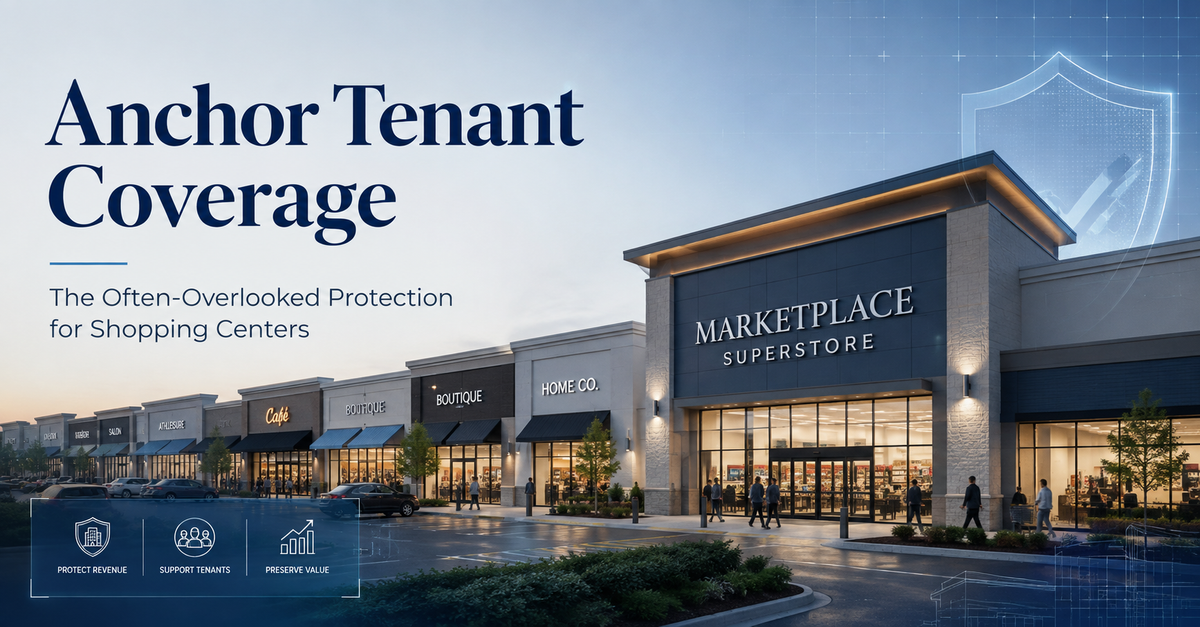
Consider a neighborhood shopping center anchored by a large grocery store. The grocery store may occupy a significant portion of the square footage, but its importance goes well beyond the rent it pays.
Customers visiting the grocery store may also pick up coffee, visit the dry cleaner, eat at a restaurant, stop at a pharmacy, or shop at one of the smaller retailers in the center. The anchor effectively becomes a traffic generator for the entire property.
Now imagine the grocery store suffers a major fire.
The shopping center owner's building may suffer little or no physical damage. The smaller retail spaces may remain completely operational. From a traditional property insurance perspective, it may appear that the owner has avoided a significant loss.
Economically, however, the situation could look very different.
Customer traffic may fall dramatically while the grocery store is closed. Smaller tenants may experience declining revenue. Some may begin requesting rent concessions. Others may exercise rights contained within their leases. Prospective tenants may become less interested in leasing vacant space, and existing tenants approaching renewal may reconsider staying at the property.
A single loss at one tenant's premises can therefore create consequences throughout the entire shopping center.
That is where coverage associated with anchor tenants becomes important.
The Coverage May Have a Different Name
One of the reasons this exposure is overlooked is that there is not always a policy provision literally titled "Anchor Tenant Coverage."
Depending upon the insurance carrier and policy form, the protection may appear as an extension or endorsement involving dependent properties, contributing properties, leader properties, or contingent business income.
The terminology matters because insurance policies respond based on their specific wording.
A "leader property" is generally a nearby business or attraction that draws customers to the insured location. For a shopping center owner, an anchor tenant can be the textbook example of this exposure.
If properly structured, the coverage may help protect the property owner when covered physical damage at the anchor tenant's location results in a loss of business or rental income for the insured property.
Without the appropriate endorsement, the owner could discover that traditional business income coverage is not enough.
Why Standard Business Income Coverage May Not Solve the Problem
Traditional business income coverage generally focuses on income lost because covered physical damage affects the insured's own property.
That distinction is critical.
Suppose the insured owns a retail center containing 20 stores. The anchor tenant occupies a separately insured portion of the property and experiences a severe covered loss. The owner's remaining building is still accessible, and the other tenants can continue operating.
There may be very little direct physical damage to the owner's insured premises.
Nevertheless, the financial impact could be significant.
If business income coverage requires damage to property at the insured premises before coverage is triggered, the owner could experience a very real economic loss without the traditional policy responding as expected.
A properly designed dependent property or leader property endorsement can address that gap, subject, of course, to the specific policy language, limits, waiting periods, causes of loss, and other conditions.
The Lease Language Makes the Exposure Even More Important
Insurance cannot be analyzed independently from the leases governing a shopping center.
Many retail leases contain provisions that become particularly important when an anchor tenant disappears or stops operating.
For example, a smaller tenant may have negotiated protections tied to the continued operation of certain major tenants or a minimum percentage of occupied retail space. These provisions are commonly associated with co-tenancy requirements.
Depending upon the lease, failure to satisfy those requirements could allow a tenant to reduce its rent, convert to alternative rent arrangements, or potentially terminate its lease.
That means the loss of an anchor can create a cascading effect.
The owner could first lose revenue associated with the damaged anchor space. Then neighboring tenants could seek rent reductions. Some may leave. Vacancies could increase. Leasing activity could slow. The property's net operating income could deteriorate.
For an owner focused on maintaining occupancy and property value, this is far more than an insurance technicality.
It is an asset-management issue.
Not Every Anchor Tenant Creates the Same Risk
A shopping center owner should also consider how dependent the property actually is on each major tenant.
A large tenant occupying 40 percent of a center does not automatically represent the greatest exposure. In some cases, a smaller grocery store or highly recognizable retailer may generate substantially more customer traffic than a larger tenant.
The nature of the center matters as well.
A grocery-anchored neighborhood center has a different dependency profile from a luxury retail center, outlet center, entertainment-oriented complex, or power center containing several big-box retailers.
The surrounding area can also change the analysis. If customers have numerous alternatives nearby, the temporary loss of an anchor may significantly affect shopping patterns. Conversely, a center in an extremely strong retail corridor may be able to absorb the disruption more easily.
Understanding the exposure therefore requires more than looking at tenant square footage.
It requires understanding why people come to the property.
Coverage Limits Deserve Particular Attention
Even when anchor-related coverage exists, another problem frequently appears: the limit is too small.
Dependent property extensions are sometimes included within commercial property policies with relatively modest sublimits. On a large shopping center, that amount may bear little relationship to the potential financial impact of losing a major traffic-generating tenant for six months, twelve months, or longer.
Owners should consider how long it could realistically take an anchor tenant to return after a major property loss.
Rebuilding a large retail space may require demolition, construction, permits, specialized equipment, inspections, and coordination with the tenant. A national retailer may also decide whether reopening the location makes economic sense.
That creates another important question.
What happens if the anchor does not come back?
The difference between a temporary closure and a permanent departure can be enormous for the property owner, and policy language must be reviewed carefully to understand what circumstances actually qualify for coverage and for how long.
The Conversation Should Start Before a Loss
Shopping center insurance should not simply be a process of collecting building values, applying a replacement cost per square foot, and requesting quotes.
A broker should understand the property's economics.
Who are the anchors? How much traffic do they generate? How long are their leases? Are there co-tenancy clauses involving other tenants? Are any major leases approaching expiration? How much rental income could realistically be affected if an anchor suffered a major loss? Is there dependent property or leader property coverage in the current policy? What limit applies? What causes of loss trigger it?
Those questions can reveal exposures that would never be apparent from a statement of values alone.
This is particularly important for owners with portfolios containing multiple retail centers. One property may be highly dependent on a single grocery anchor, while another may have several independent traffic generators. Applying the same insurance structure to every location may therefore create unnecessary gaps.
Protecting the Building Is Only Part of Protecting the Investment
Retail real estate illustrates an important principle of commercial insurance: sometimes the greatest financial loss does not begin with damage to your own building.
It can begin next door.
An anchor tenant can influence customer traffic, occupancy, rental income, lease negotiations, and ultimately the value of the entire shopping center. Yet the insurance protection addressing that dependency can be buried within a property policy endorsement, restricted by a small sublimit, or missing altogether.
For shopping center owners, reviewing anchor tenant exposure should therefore be part of every serious property and business income insurance analysis.
The building may be fully insured for replacement cost and still leave the owner exposed to one of the property's most important economic risks.
A comprehensive insurance program should protect not only the physical structure of the shopping center, but also the network of tenants and revenue streams that make that real estate valuable in the first place.
Sarmad Naqvi, CLCS