Multifamily vs. Office: Why Similar Buildings Can Create Very Different Insurance Risks

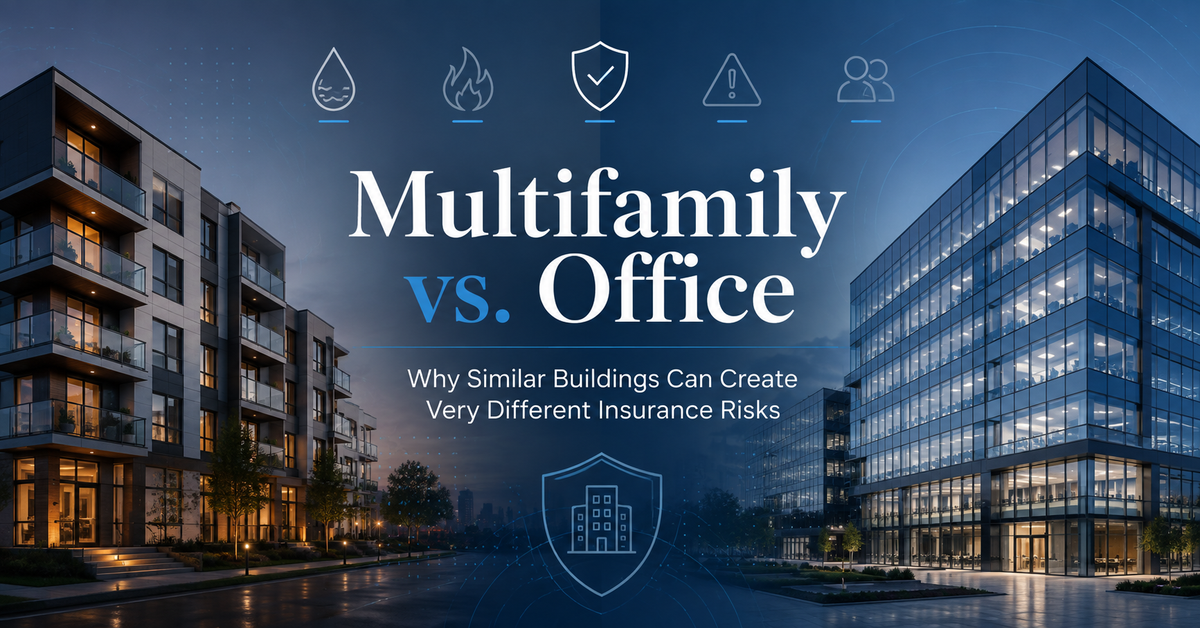
Two buildings can sit across the street from one another, have similar square footage, similar construction, and even similar replacement values, yet represent completely different risks to an insurance company.
One could be an office building. The other could be multifamily.
From the outside, they may not appear dramatically different. From an insurance and risk-management perspective, however, the difference is significant.
The primary reason is occupancy. People work in one building. They live in the other.
That simple distinction changes everything from fire and water exposure to liability, business income, security, maintenance, and ultimately how insurance carriers underwrite the property.
Multifamily Is a 24-Hour Risk.
An office building may be heavily occupied during the workday but relatively quiet overnight and on weekends. Multifamily properties operate around the clock.
Residents are constantly cooking, showering, using appliances, doing laundry, charging electronics, entertaining guests, and going about their daily lives.
Every one of those activities creates opportunities for losses.
Consider water damage.
A large multifamily property may contain hundreds of toilets, sinks, showers, refrigerators, washing machines, dishwashers, and water supply lines. A relatively small plumbing failure on an upper floor can quickly spread into several units below.
In a high-rise residential building, one failed connection can potentially affect multiple floors.
Water damage can occur in an office building as well. Still, the frequency and nature of the exposure are different because the building is not functioning as hundreds of individual homes.
Fire presents a similar distinction.
A 200-unit apartment building may effectively contain 200 individual kitchens. Each resident has control over how that kitchen is used.
An office building of comparable size may have only a handful of break rooms, kitchenettes, or other cooking areas.
From an underwriting standpoint, that matters.
The Human Element Is Much Greater in Multifamily
One of the largest differences between multifamily and office properties is the amount of control the property owner has over what happens inside the building.
Commercial tenants generally operate under detailed leases and use their space for a defined business purpose.
Residential tenants live their lives inside their units.
Residents may leave food cooking unattended, overload an electrical outlet, leave water running, turn off a smoke detector, bring unauthorized pets into the building, use space heaters, or allow guests into the property.
Most property owners do everything possible to operate a safe building, but they cannot completely control resident behavior.
Insurance companies understand that.
The greater the number of human variables, the more difficult certain losses become to predict and prevent.
Liability Looks Different Too
Multifamily properties can also create substantially different liability exposures.
Residents and their guests use hallways, elevators, parking garages, stairwells, swimming pools, fitness centers, courtyards, rooftops, balconies, laundry rooms, and other common areas at all hours.
A multifamily owner may face claims involving slips and falls, negligent security, inadequate lighting, dog bites, swimming pools, balconies, habitability issues, water intrusion, mold, elevators, or building maintenance.
When something goes wrong, there is also an important distinction: the building is someone's home.
A water leak in an office may damage furniture, equipment, or tenant improvements.
A water leak in an apartment may destroy someone's personal property, displace a family, and create allegations that the unit is no longer habitable.
That can transform what begins as a relatively straightforward property loss into a much more complicated liability situation.
Office buildings certainly have liability exposures, but they are often more controlled. Occupants are generally employees, commercial tenants, vendors, and invited visitors, and access to the building may be much more predictable.
Office Buildings Have Their Own Complex Risks
Office properties should not be considered low-risk simply because their exposures are different.
Large office buildings often contain sophisticated HVAC equipment, elevators, electrical infrastructure, building automation systems, security systems, glass exteriors, and other expensive mechanical components.
A major equipment failure can create a substantial loss.
If a central HVAC system fails, for example, portions of an office building may become unusable until repairs are completed. Specialized equipment can also have long replacement lead times, particularly in older buildings.
Tenant improvements create another important issue.
Law firms, technology companies, financial institutions, medical offices, and other commercial tenants may invest substantial amounts of money into customized interiors.
After a loss, determining whether those improvements are the responsibility of the landlord, the tenant, or both can become complicated.
That is why lease language and insurance coverage need to work together.
Vacancy Is Particularly Important for Office Properties
Vacancy affects every type of real estate, but it can create a particularly challenging exposure for office buildings.
A multifamily building might move between 92% and 97% occupancy while continuing to operate normally.
An office building can lose one large tenant and suddenly have several floors sitting vacant.
Vacant areas may have fewer people available to notice water leaks, vandalism, mechanical problems, or other developing losses.
Insurance carriers therefore pay close attention to office occupancy.
A building that is 95% occupied can be a very different underwriting risk from the same building at 55% occupancy.
Business Income Needs to Be Evaluated Differently
The way the two properties generate income also changes the insurance exposure.
A multifamily property's rental income is generally spread across many individual tenants.
If a loss makes 15 apartments temporarily uninhabitable, the property may lose income from those units while the remainder of the building continues generating rent.
Office buildings can have much greater tenant concentration.
If one tenant occupies 30% or 40% of the property, a major loss affecting that tenant's space can have an outsized financial impact.
Accurately calculating business income coverage therefore requires more than looking at annual rental income.
The analysis should consider lease terms, tenant concentration, operating expenses, reconstruction timelines, tenant improvements, and how long it could realistically take to restore and re-lease damaged space.
Loss Control Should Match the Property
Because multifamily and office properties have different exposures, their loss-control programs should also be different.
For multifamily owners, water detection systems and automatic shutoff valves can be extremely valuable. Property owners may also benefit from reviewing cooking-fire prevention, lighting, access control, balconies, pools, stairways, handrails, and other residential liability exposures.
For office buildings, greater attention may be placed on mechanical systems, roof maintenance, electrical infrastructure, fire protection, vacant-space inspections, tenant improvements, lease requirements, and contractual risk transfer.
The goal should never be to complete an insurance company's loss-control checklist.
The goal should be to identify the exposures most likely to create a significant loss and reduce them before a claim occurs.
That can also improve how the insurance marketplace views the property.
The Insurance Strategy Should Follow the Real Estate Strategy
Ultimately, a multifamily property should not be insured as though it is simply another commercial building.
Neither should an office property.
The occupancy changes the risk.
The claims change.
The liability changes.
The business income exposure changes.
And the insurance marketplace can change as well.
This becomes particularly important for real estate owners with diversified portfolios. An organization that owns multifamily, office, retail, hospitality, or other asset classes should not view its insurance program as simply a schedule of buildings and values.
Each property has an operating risk that needs to be understood.
A knowledgeable commercial real estate insurance broker should be doing more than obtaining quotes at renewal. The broker should understand how the property operates, identify the exposures that matter to underwriters, recommend practical loss controls, and present the risk to the insurance marketplace in the strongest possible way.
The better the insurance strategy reflects the actual real estate risk, the better positioned an owner is to protect both the property and the long-term value of the investment.
Sarmad Naqvi, CLCS