Ember-Resistant Vents: A Critical Line of Defense Against Wildfire Losses

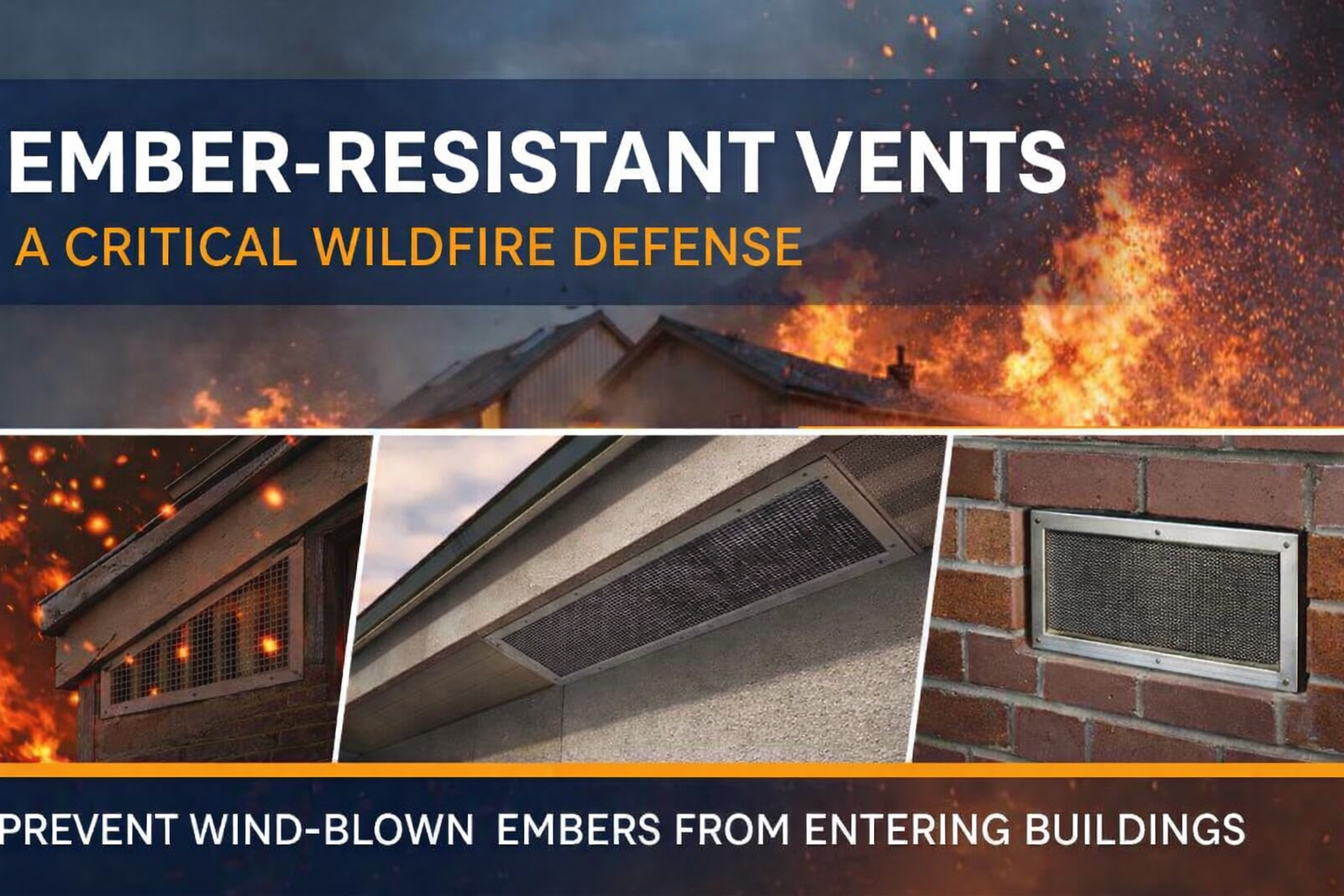
Wildfires rarely destroy buildings solely through direct flame contact. In fact, research consistently shows that wind-driven embers (also called firebrands) are responsible for the majority of structural ignitions during wildfire events. These embers can travel miles ahead of the fire front, finding their way into buildings through small openings — especially vents. Ember-resistant vents are specifically designed to block these embers while still allowing proper airflow, making them a critical component of modern wildfire-resilient construction for both residential and commercial properties.
What Are Ember-Resistant Vents?
Ember-resistant vents are ventilation systems or vent covers engineered to prevent burning embers from entering a building’s interior cavities, such as attics, crawl spaces, wall voids, and mechanical plenums.
Unlike traditional vents — which are often open or protected only by coarse insect screens — ember-resistant vents use a combination of:
- Fine, non-combustible metal mesh (typically 1/8” or 1/16” openings)
- Baffled or louvered internal designs that disrupt ember paths
- Heat-activated (intumescent) materials that expand and seal openings under extreme heat
- Fire-tested assemblies compliant with wildfire exposure standards
Some well-known examples include engineered systems such as Vulcan Vents, which are tested to ASTM wildfire standards and approved in many Wildland-Urban Interface (WUI) jurisdictions.
Why Vents Are One of the Biggest Wildfire Vulnerabilities
Vents are essential for moisture control, temperature regulation, and indoor air quality — but they also represent one of the most common entry points for embers during a wildfire.
Once embers enter:
- They can ignite insulation, framing, or stored materials.
- Fires may smolder undetected inside attics or walls.
- Structural failure often occurs after the fire front has passed, when suppression resources are no longer present.
Studies by organizations such as the Insurance Institute for Business & Home Safety show that buildings with unprotected vents experience significantly higher ignition rates, even when roofs and exterior walls remain intact.
Where Ember-Resistant Vents Are Used
These systems are widely used in both residential and commercial properties, including:
Residential Applications
- Attic vents (ridge, gable, soffit)
- Crawl space and foundation vents.
- Roof and dormer vents
- Utility and exhaust vents (often with auto-closing dampers)
Commercial & Multifamily Applications
- Mechanical penthouse vents
- Roof and plenum ventilation openings
- Foundation and parking podium vents
- Low-rise buildings with attic or concealed roof cavities
- Mixed-use and multifamily developments in wildfire-exposed zones
The same principle applies across all property types: any opening connecting the exterior to combustible interior spaces is a potential ignition pathway unless protected.
How Ember-Resistant Vents Help Minimize Fire Losses
Ember-resistant vents reduce wildfire risk in several critical ways:
- Block ember intrusion into attics, walls, and crawl spaces
- Reduce hidden interior ignitions, which are among the hardest fires to detect and suppress
- Maintain required ventilation to prevent moisture, mold, and heat buildup.
- Slow or prevent fire spread, buying valuable time for emergency response.
- Improve overall building survivability, even in high-intensity wildfire conditions.
When combined with other hardening measures — such as Class A fire-rated roofs, defensible space, and non-combustible exterior materials — these vents significantly improve a structure’s resilience.
Insurance Benefits: Why Carriers Care About Ember-Resistant Vents
From an insurance perspective, ember-resistant vents directly address one of the most common mechanisms of wildfire loss.
As a result, insurers increasingly view them as a loss-mitigation feature, which can:
- Strengthen underwriting submissions for wildfire-exposed properties.
- Support more favorable renewal terms where available.
- Reduce the likelihood of coverage restrictions, exclusions, or non-renewals
- Improve eligibility for certain admitted or specialty markets.
- Demonstrate proactive risk management to carriers and reinsurers.
For HOAs, commercial owners, and multifamily operators, these vents can be a relatively low-cost retrofit compared to the potential severity of wildfire losses — and they are often favorably viewed during insurance reviews.
A Small Upgrade with Outsized Impact
Wildfire resilience is no longer optional in many regions — it is a core risk-management issue. Ember-resistant vents are among the most effective, science-backed upgrades available to reduce ignition risk without compromising building performance. For property owners, HOAs, and commercial operators in wildfire-exposed areas, these vents are not just a building upgrade — they are an insurance, safety, and asset-protection strategy.