Dr. Jekyll, Mr. Hyde, and Why LinkedIn Still Feels Human

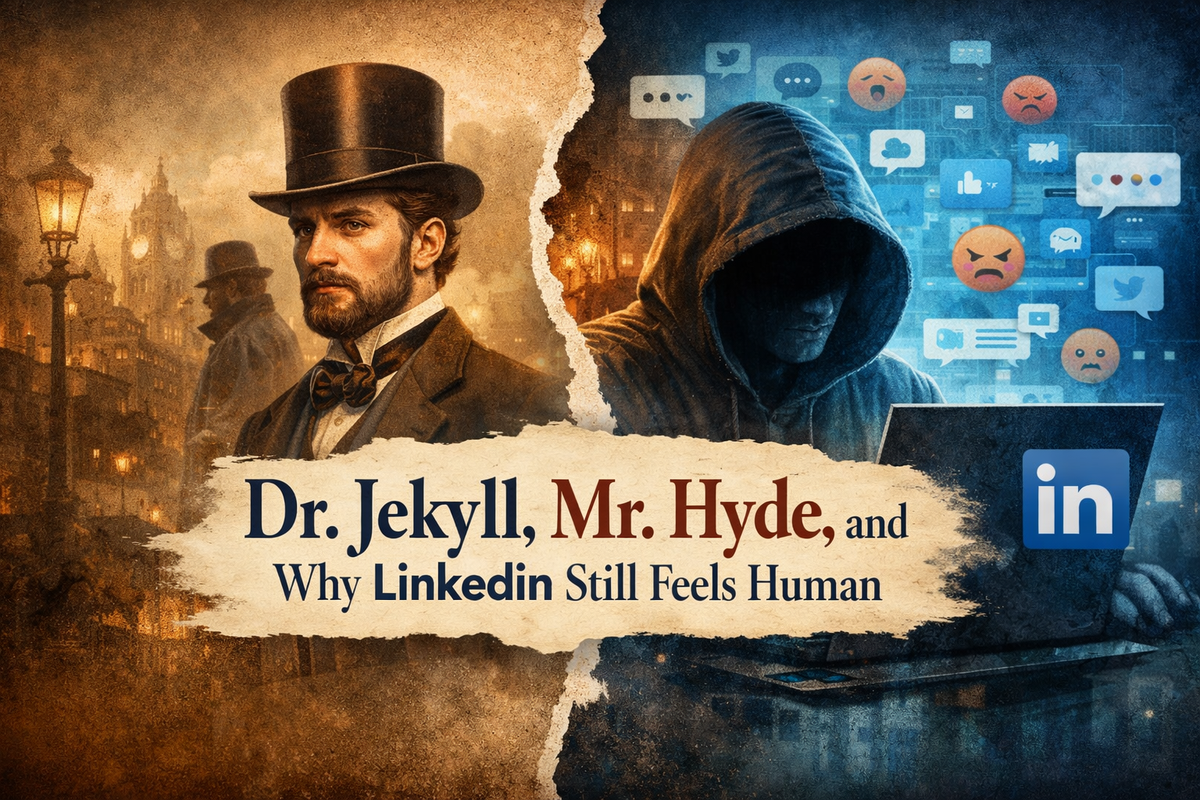
When people think about Strange Case of Dr Jekyll and Mr Hyde, they often describe it as a story about split personality: a respectable man on one side and a violent alter ego on the other. That interpretation is understandable, but it is the wrong interpretation of the deeper point Stevenson was making.
The novella is not about mental illness. It is about what happens when a person believes they can act without consequences. Hyde is not a second mind or a fractured identity. He is a mask. Jekyll does not forget what Hyde does, nor does he lose control. He chooses Hyde because Hyde allows him to indulge impulses that polite society forbids while keeping his reputation intact. Hyde exists so Jekyll can tell himself that certain actions do not truly belong to him. In the original novella, the final confession of Hyde is written while in Jekyll’s body. He knows everything he has done and consistently refers to himself as “I.” Movie adaptations depict this character as having a more distinct identity disorder. Movie adaptations show that each person has their own mind and is not really responsible for another person's actions. How the original novella is misunderstood is perfectly paralleled in real life today in online behavior.
The internet did not invent cruelty, selfishness, or hatred. What it did was make them cheaper. When identity is obscured, and accountability disappears, people speak and act in ways they never would in person. Empathy erodes, language hardens, and escalation feels safe because consequences feel distant or nonexistent. Anonymity does not create darker impulses; it simply removes the social friction that once restrained them. There is a reason phones and computer screens are called dark mirrors.
This is why phrases like “I was just trolling” or “it’s just the internet” feel so familiar. They are modern versions of Jekyll’s justification. They allow people to separate their behavior from their sense of self, to outsource harm to a version of themselves that “doesn’t count.” Stevenson’s warning is clear and uncomfortable: moral outsourcing does not erase responsibility. It only postpones it.
This is what makes LinkedIn feel different from much of the rest of the internet.
LinkedIn is one of the few major platforms where anonymity is largely absent. Your name, role, professional history, and, often, your employer are visible. Your words are attached to you in ways that can influence trust, credibility, and opportunities. Even long after a post is deleted, its impression can remain.
Because of that, people behave differently here. Not because LinkedIn users are somehow more virtuous, but because accountability remains. When words have consequences, people slow down. They choose language more carefully. They think about how they are perceived, but also about how they impact others. The presence of identity reintroduces restraint, and restraint makes room for empathy.
In Dr. Jekyll and Mr. Hyde, Hyde grows stronger precisely because the mask works. The lack of consequence teaches him what is permissible, and each transformation makes the next one easier. Jekyll does not lose control in a single moment; he relinquishes it gradually, choice by choice, because the disguise protects him from immediate harm. The tragedy is not that Hyde exists, but that Jekyll keeps choosing him.
The same dynamic plays out at scale online. Where anonymity dominates, cruelty escalates. Where identity is visible, behavior moderates. Where people are accountable for their words, humanity tends to reappear. Platforms shape behavior not through ideology, but through consequences.
One of the healthiest aspects of LinkedIn is that your words belong to you. They reflect your judgment, your values, and your professionalism. That reality does not silence people; it grounds them. It reminds us that communication is not just expression, but responsibility.
Stevenson’s story endures because its insight is timeless. Who we are when no one is watching matters. But who we are when our name is attached to our words may matter even more.
In a digital world full of masks, LinkedIn quietly insists on something increasingly rare: speak as yourself, and live with what you say. That may be why real conversations still happen here.
My writing here does not necessarily serve a business purpose; it’s more of my personal observations. Thank you for reading my thoughts.