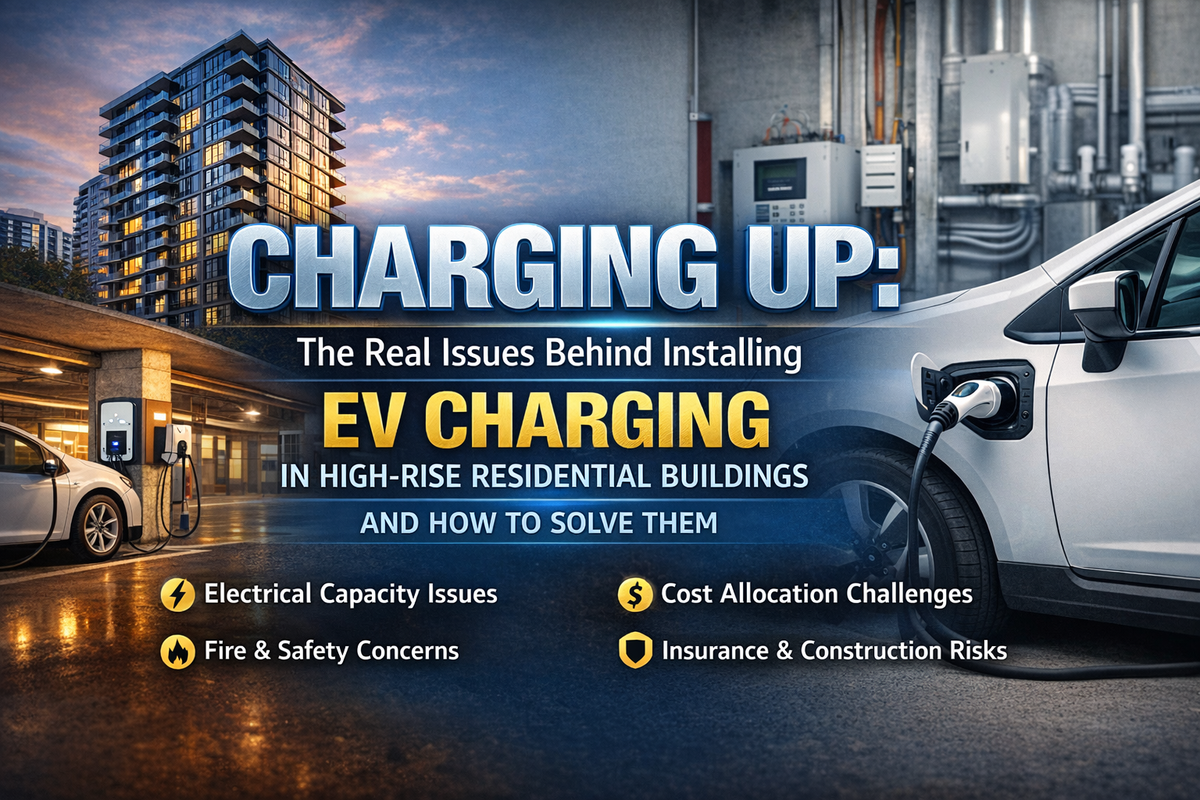
Charging Up: The Real Issues Behind Installing EV Charging in High-Rise Residential Buildings — And How to Solve Them

Electric vehicles are no longer a niche product in California — they are the future. With state mandates pushing toward 100% zero-emission vehicle sales in the coming years, high-rise residential buildings are facing a new and urgent question:
How do we install EV charging infrastructure safely, fairly, and cost-effectively in a vertical environment that was never designed for it?
Unlike garden-style apartments or single-family homes, high-rise residential buildings present unique structural, electrical, operational, and insurance challenges. Installing charging stations is not simply a matter of adding outlets to a garage wall.
Below are the most significant issues facing high-rise residential properties — and the solutions boards, developers, and property managers should evaluate.
1. Electrical Capacity Constraints
Most high-rise buildings were designed decades ago — long before EV charging was contemplated. The existing electrical infrastructure may not have:
- Adequate transformer capacity
- Spare panel space
- Distribution pathways to parking levels
- Load margin for simultaneous charging
In some older buildings, adding even a handful of Level 2 chargers can exceed available capacity.
Solutions:
- Comprehensive load study performed by an electrical engineer
- Smart load management systems that balance charging demand
- Phased infrastructure installation (future-proofing conduit now)
- Utility coordination for service upgrades
- Exploring energy storage or solar integration
A strategic approach avoids costly rework and minimizes future special assessments.
2. Cost Allocation & Equity Among Owners
High-rise HOAs often struggle with a fundamental question:
Should all owners pay for infrastructure if only some use it?
This becomes especially contentious in luxury towers where parking is deeded or assigned.
Key Considerations:
- Backbone infrastructure vs. individual charger costs
- User-pay models
- Licensing agreements for exclusive use
- Reserve funding vs. special assessments
- Compliance with California “Right to Charge” laws
Many associations implement a common infrastructure funded by the HOA, with individual owners paying for their dedicated charging equipment and usage.
Clear amendments to governing documents and board resolutions are critical to avoid disputes.
3. Fire Risk & Life Safety Concerns
Lithium-ion battery fires are rare — but when they occur, they are intense and difficult to extinguish. In a confined underground garage, risk perception alone can create anxiety among residents.
Primary Risks:
- Thermal runaway events
- Increased electrical fire exposure
- Ventilation concerns
- Water damage from suppression systems
Solutions:
- Review the adequacy of the fire suppression system.
- Coordinate with the local fire department.
- Install monitored charging stations.
- Use UL-listed equipment only.
- Develop emergency response protocols.
From a risk management perspective, boards should review:
- Property coverage limits (replacement cost adequacy)
- Ordinance & law coverage
- Equipment breakdown coverage
- Umbrella/excess liability capacity
This is particularly important in older Bay Area high-rises where infrastructure retrofits can trigger code upgrades.
4. Insurance Implications
EV charging installations affect multiple lines of coverage:
- Property (added equipment and infrastructure)
- General Liability
- Directors & Officers (board decision disputes)
- Equipment Breakdown
- Builder’s Risk during installation
Common insurance pitfalls include:
- Failing to report capital improvements
- Not reviewing contractor indemnification.
- Improper additional insured status
- Lack of subrogation waivers
A coordinated broker review ensures the association’s risk transfer strategy evolves alongside infrastructure upgrades.
5. Structural & Physical Constraints
Running conduit through post-tension slabs, navigating tight garage clearances, and protecting exposed wiring in active parking environments creates real complexity.
Additional challenges include:
- ADA accessibility compliance
- Waterproofing penetrations
- Corrosion protection in coastal environments
- Managing construction disruption
A phased and engineered design reduces structural risk and long-term maintenance exposure.
6. Operational & Management Challenges
Once installed, EV systems require:
- Billing management
- Software platform oversight
- Maintenance agreements
- Enforcement policies
- Clear architectural standards
Without structure, disputes can arise around shared chargers, cable management, or unauthorized installations.
Boards should adopt a formal EV Charging Policy outlining:
- Installation requirements
- Insurance obligations of owners
- Indemnification language
- Maintenance responsibility
- Removal conditions
A Strategic Approach for High-Rise Boards
The most successful buildings approach EV charging not as a reactive amenity — but as a long-term infrastructure strategy.
A prudent roadmap includes:
- Electrical feasibility study
- Fire/life safety review
- Cost allocation model
- Governing document alignment
- Insurance review
- Phased implementation
For high-rise communities in California — particularly in dense urban markets like San Francisco and Oakland — proactive planning now can prevent costly retrofits later.
Final Thought
EV charging in high-rise residential buildings is no longer optional. It is becoming an expected amenity and, in some cases, a regulatory requirement.
But without proper planning, it can create financial strain, operational headaches, and uninsured exposures.
With thoughtful engineering, clear governance, and coordinated risk management, high-rise associations can turn EV charging from a liability into a value-enhancing asset.